
- Healthcare facilities have many unique hazards that can potentially affect the health of employees to include chemical hazards
- These hazards increase risks related to OSHA and also the EPA if there is a HAZMAT spill
- Some of these risks can be eliminated by product substitution to a clinically and therapeutically safer equivalent
- More than 10,000 healthcare facilities have switched away from toxic Ethyl Chloride to the safer, more economical topical anesthetic spray CryoDose TA
- Not only is it safer but costs less and can be disposed of in regular trash
The High Cost and Danger of Ethyl Chloride To Your Practice: Its Alarmingly Adverse Effects on The Health of Your Team and Budget
Today, budget and operational pressures on medical practices, hospitals, surgery centers, and other healthcare facilities significantly impact operations. Budgets and workplace safety are significant contributors to success in any healthcare setting. For medical facilities that use Ethyl Chloride, switching to CryoDose TA will easily and seamlessly help your facility avoid health and environmental issues associated with this toxic product. Moreover, switching to CryoDose TA will save your facility money that can be better invested elsewhere.
Save Money
CryoDose TA offers healthcare facilities a meaningful opportunity to save money immediately. If your facility uses toxic Ethyl Chloride, you have an opportunity to realize substantive savings. Here’s how:
Ethyl Chloride users:
- Higher acquisition cost per unit
- Pay mandatory HAZMAT shipping fees – on average, between $240 and $360 annually*
- Risk of HAZMAT spill costing up to $5,000 in clean up costs
- Pay HAZMAT disposal fees – depending on use and region, about $1,200 or more per month with a service agreement and about $400 or more for contract HAZMAT pick-up**
- Limited use indications, requiring the purchase of other patient pain management options
*Based on 12 shipments per year and depending on your supplier
**Based on a national average of HAZMAT disposal contracts and per-incident disposal fees, Nuance Medical Research
With CryoDose TA, users benefit because:
- Lower acquisition cost per unit
- $0 HAZMAT shipping fees
- $0 for risk of HAZMAT spill
- $0 HAZMAT disposal fees because it can be disposed of in normal trash
- More indications for use making CryoDose TA more cost-effective and economical
HAZMAT Danger in Your Practice: Team Safety
Over 10,000 healthcare facilities have chosen CryoDose TA over Ethyl Chloride. Ethyl Chloride is extremely flammable and recognized as a HAZMAT substance by the CDC, and OSHA. According to the EPA, “Sources of possible Ethyl Chloride exposure include the inhalation of contaminated air…” A study by the National Toxicology Program (NTP) cited in the same EPA paper, indicated that inhaled Ethyl Chloride is carcinogenic in female mice and may be carcinogenic in rats.
We are all now more aware than ever of environmental risks. Patients and employees are well aware of environmental factors which may adversely impact their health. Switching from toxic Ethyl Chloride to CryoDose TA allows you to reduce those risks while offering a superior topical anesthetic spray at a lower cost of acquisition.

Ethyl Chloride by many measures is dangerous to humans through inhalation and skin absorption. The known dangers to humans from Ethyl Chloride use are as follows:
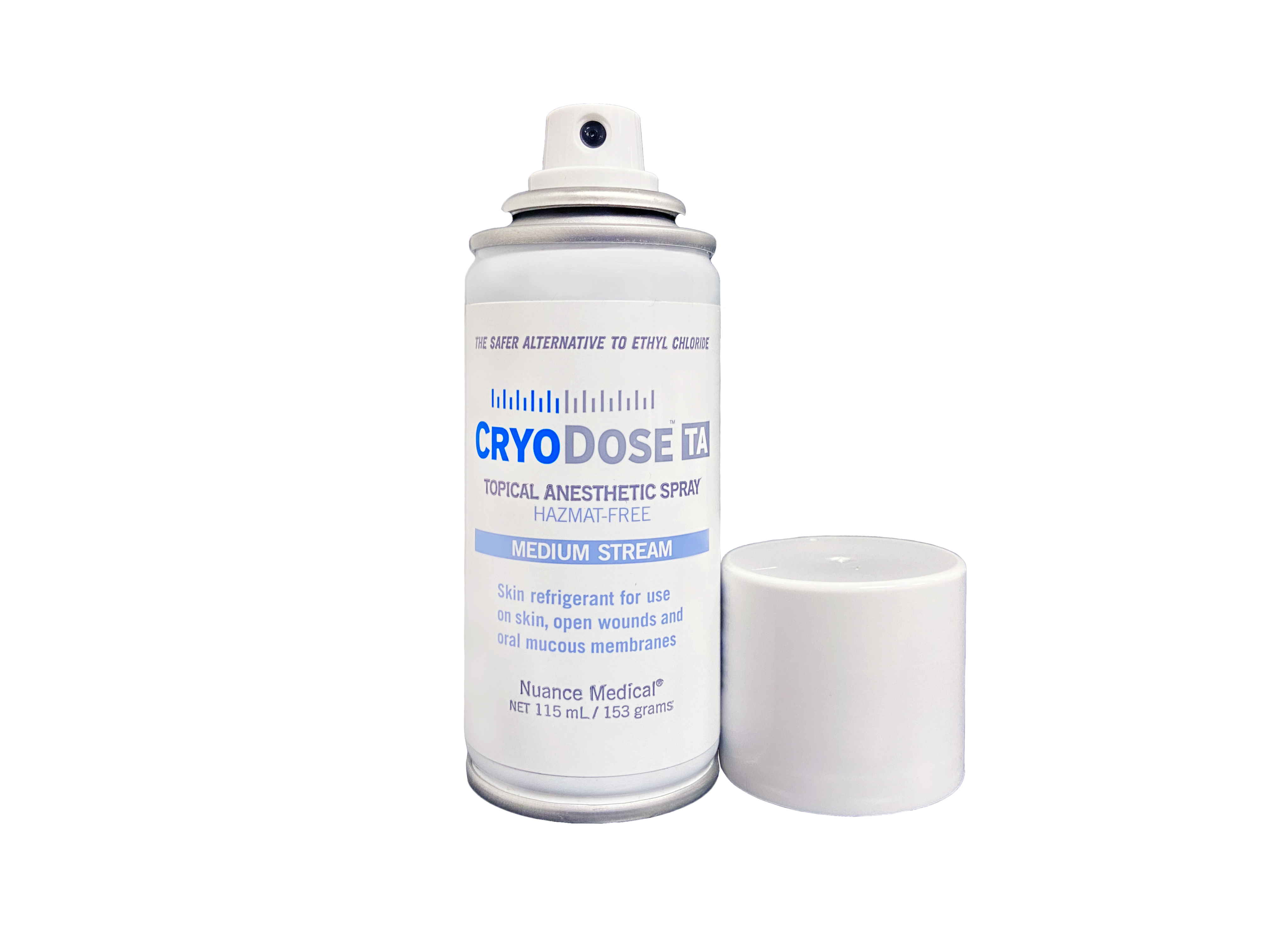
CryoDose TA is:
Switching to the safer CryoDose TA from the dangers of toxic Ethyl Chloride is simple. The switch has already been made by over 10,000 healthcare facilities. This easy yet powerful choice helps medical providers use more environmentally friendly and safer products which are better for staff and budgets.
Practice Safety: Ethyl Chloride and The Real Risk to Every Practice
You may already know some of the taxing financial costs related to purchasing Ethyl Chloride – additional costs related to the shipping and disposal of toxic and hazardous material, but the risks to your practice go far beyond these hard dollar costs. Risks associated with toxic Ethyl Chloride are real and can be completely avoided. Healthcare practitioners and facility owners use CryoDose TA to smartly mitigate risks to their practice.
Hazards Impacting Your Team
Ethyl Chloride is dangerous to inhale and is a known liver and kidney toxin. It’s a potential catalyst for acute toxic events and is recognized as a general anesthetic. Ethyl Chloride, by many measures, is dangerous to humans through inhalation and skin absorption. The FDA’s Manufacturer and User Facility Device Experience (MAUDE) database has documented incidents of patients being burned due to the application of Ethyl Chloride and a heat source.
Furthermore, it is highly likely that the Ethyl Chloride brown bottle is the last remaining glass item in your facility.
OSHA Exposure and Risk
Ethyl Chloride creates an additional and unnecessary exposure to OSHA issues for your healthcare facility. OSHA requires organizations to provide hazard communication training when a worker is initially assigned to a position that has the potential for hazardous chemical exposure. Potential OSHA reporting by employees due to an unsafe workspace may be rare, but the risk is real and could disrupt your patient flow and practice, along with time to complete the required regulatory paperwork for compliance.
Furthermore, the Environmental Protection Agency (EPA) requires healthcare facilities to develop and maintain written plans on how they respond to toxic spills in the workplace. The EPA provides specific instructions on how to report toxic spills in the workplace and gives healthcare facilities the option of evacuating personnel and requesting a professional response team to clean up any spills. Should healthcare facilities choose these options over having employees trained to handle spills, contingency plans must clearly outline who these outside contractors/resources are and their obligations relative to the spill.
Practice Downtime Risk: Practice Interruption
Practice interruption impedes the great care your healthcare facility delivers, impacting your patient care and your practice’s bottom line. Possible practice interruptions from Ethyl Chloride use are as follows:
- OSHA reporting from Ethyl Chloride requires time and resources, filing paperwork with Federal, State, and Local regulatory bodies
- Potential OSHA fines
- Stocking and restocking hazardous material cleanup materials such as adsorbents and PPE
- Crisis management communications require time and resources
Employee Satisfaction
Ensuring the personal safety of your employees by providing the safest possible environment and workspace is simply good business. Finding and keeping great employees to keep your practice performing in top condition is a competitive task. Assuring your employees that you are taking every measure to ensure their health and safety is paramount to building a culture that delivers consistent employee satisfaction scores. Healthcare is a relatively small community, and employer reputation is a key driver to recruiting talent. Mitigating and removing possible risks to your employees reinforces your commitment to workplace safety.
Switch to Safer. Switch for Good.
Certainly, almost every healthcare facility takes on hazardous material risk. It’s the nature of the business. Over 10,000 medical practices and facilities have chosen CryoDose TA over toxic Ethyl Chloride as one, but meaningful way, to reduce risks and taxing costs, in an effort to make their facility the best it can be.
References & Citations
Ethyl Chloride Toxicity
CDC recommends that Ethyl Chloride be treated in the workplace with caution because of its structural similarity to the four chloroethanes (ethylene dichloride; hexachloroethane; 1,1,2,2-tetrachloroethane; and 1,1,2-trichloroethane) shown to be carcinogenic in animals. Click here to learn more.
The American Conference of Governmental Industrial Hygienists (ACGIH®) carcinogenicity designation Click here to learn more.
British Journal of Anesthesia article on Ethyl Chloride as a general anesthetic. Click here to learn more.
National Toxicology Program (NTP) study indicated that inhaled Ethyl Chloride is carcinogenic in female mice and may be carcinogenic in rats. Click here to learn more.
The National Capital Poison Center (NCPC), details that in animal studies, Ethyl Chloride exposure was associated with an increase in uterine and liver tumors in female mice. Click here to learn more.
European Chemicals Agency (ECHA), the classification provided by companies to ECHA in REACH registrations identifies that Ethyl Chloride may damage fertility or the unborn child and contains gas under pressure and may explode if heated. Click here to learn more.
Ethyl Chloride Occupational Airborne Exposure Limits
OSHA The legal airborne permissible exposure limit (PEL) of Ethyl Chloride is 1,000 ppm averaged over an 8-hour work shift. Click here to learn more.
*OSHA recognizes that many of its permissible exposure limits (PELs) are outdated and inadequate for ensuring protection of worker health. OSHA recommends that employers consider using the alternative occupational exposure limits because the Agency believes that exposures above some of these alternative occupational exposure limits may be hazardous to workers, even when the exposure levels are in compliance with the relevant PELs.
ACGIH® TLV® (Threshold Limit Value) Click here to learn more.
Cal/OSHA The permissible exposure limit of Ethyl Chloride is 100ppm averaged over an 8-hour work shift. Click here to learn more.
ECHA Occupational Exposure Limits of Ethyl Chloride is 100ppm. Click here to learn more.
Ethyl Chloride Fact Sheets
EPA, Health Effects Notebook for Hazardous Air Pollutants, Ethyl Chloride Click here to learn more.
World Health Organization, INCHEM, Ethyl Chloride Click here to learn more.
Ethyl Chloride Info, State Agencies
California Office of Environmental Health Hazard Assessment (OEHHA), California Proposition 65 warning listing Ethyl Chloride as causing cancer. Click here to learn more.
New Jersey Department of Health and Senior Services, Toxic Chemical Fact Sheet, Ethyl Chloride Click here to learn more.